|
Glittering Stones >> Semi
Precious Stones >> Baddeleyite
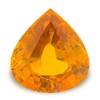
Semi Precious Stone Baddeleyite
Baddeleyite is a rare zirconium oxide mineral
occurring in a variety of monoclinic prismatic crystal forms.
It is transparent to translucent, has high indices of refraction
(na=2.130, nß=2.190, and n?=2.200), and ranges from colorless
to yellow, green, and dark brown. The baddeleyite mineral has
a specific gravity of 5.5 to 6 and a Mohs hardness of 6.5. it
is a refractory mineral, with a melting point of 2700 °C.
Baddeleyite was first occurred in 1892 from Sri
Lanka, and Minas Gerais and Jacupiranga, São Paulo, Brazil. It
was named after Joseph Baddeley, who described the occurrences
in Sri Lanka.
Actually, the mineral Baddeleyete will often
be found as detrital grains in gravels. Its primary occurrence
is in high temperature veins and in syenite, carbonatite, kimberlite,
and lamproite intrusions. Because of their refractory nature and
stability under diverse conditions, baddeleyete grains, along
with zircon, are used for uranium-lead radiometric age determinations.
 |
Historical Facts of Baddeleyite
| Other Names |
Baddeleyit, Baddeleyita |
| Refractive Index |
2.130 - 2.200 |
| Chemical Composition |
ZrO2 |
| Hardness |
6.5 |
| Density |
5.4 - 6.02 |
| Crystal Group |
Monoclinic |
| Luster |
Vitreous, Greasy |
| Color |
Yellow, Green, Dark brown |
| Occurrence |
Sri Lanka, Minas Gerais and Jacupiranga, São Paulo,
Brazil; Mogok, Myanmar |
|
|
|