


Glittering Stones >> Head Ornaments
Head ornaments
Head ornaments
Crowns:
A crown is a symbolic form of headgear worn by a monarch or by a god, for whom the crown is traditionally one of the symbols of power and legitimacy (See Regalia for a broader treatment).
Circlets:
A circlet is a crown with neither arches nor a cap (internal covering).
Many ancient crowns were circlet in style, notably the original St. Edward's Crown, the coronation crown of English monarchs, which was destroyed by Oliver Cromwell during the Commonwealth of England. In fairy tales, crowns often continue to be represented in circlet form.
In the twentieth century two British consort crowns, the Crown of Queen Mary, and the Crown of Queen Elizabeth, were designed with detachable half-arches connected to crosses puttee so that they could be worn as circlets.
Former Queens Consort whose husbands had died sometimes only wore their consort crowns as circlets after his death.
Alexandra of Denmark (Queen Alexandra, widow of Edward VII of
the United Kingdom), Mary of Tieck (Queen Mary, widow of King
George V of the United Kingdom, opposite) and Elizabeth Bowes-Lyon
(Queen Elizabeth the Queen Mother, widow of King George VI of
the United Kingdom) all followed this practice.
Coronets:
A coronet is a small crown consisting of ornaments fixed on a metal ring.
The word stems from the Old French coronate, a diminutive of co (u) ronne 'crown', itself from the Latin corona (also wreath).
Traditionally such headgear is worn by nobles, and by princes and princess, rather than by monarchs, for whom the word crown is customarily reserved in formal English, while many languages have no such terminological distinction. Therefore see under crown (headgear) for the equivalents, both physical and emblematic, in other languages and cultures.
Diadems :
A diadem (from Greek 'diadem, diodes', to surround) was originally a white ribbon, ending in a knot and two stripes that were placed often on the shoulders, that surrounded the head of the king to denote his authority.
By extension, this term was applied later to a crown, generally with a circular shape. For example, the crown worn by a Pagan drifted (Anglo-Saxon king) was a diadem, as was the crown of a baron later (in some countries surmounted by three globes).
A diadem is also a jeweled ornament worn by women with the shape of a half crown, placed over the forehead (in this sense, also called tiara). In some societies it is also a wreath worn around the head.
Tiaras:
A tiara (from Persian Tara adopted in Latin as 'tiara') is a form of crown. There are two possible types of crown that this word can refer to.
Traditionally, the word "tiara" refers to a high crown, often with the shape of a cylinder narrowed at its top, made of fabric or leather, and richly ornamented. It was used by the kings and emperors of some ancient peoples in Mesopotamia. The Assyrians used to include a pair of bull horns as a decoration and symbol of authority and a circle of short feathers surrounding the tiara's top. The Persian tiara was more similar to a truncated cone, without the horns and feathers but more jewels, and a conic-shaped tip at its top. In the Roman Catholic Church, the Papal Tiara is a high cap surrounded by three crowns and bearing a globe surmounted by a cross worn by the Pope during certain ceremonies, being the symbol of his authority. Since Pope Paul VI, set aside his tiara after the Second Vatican Council, the Papal Tiara has not been worn. Pope Benedict XVI even removed the tiara from his Coat of Arms, replacing it with a miter (but with some symbolic reference to the symbolism of the tiara, still in use in the Holy See's coat of arms).
Earrings: An earring is a piece of jewellery that is worn on the ear. Earrings are often made out of metal but can also be made out of bone or similar hard material. Earrings are worn by both genders, although they are generally more commonly worn by women.
Earrings are attached to the ear through a piercing in the earlobe or some other external part of the ear, except in the case of a clip earring, which clips onto the lobe. Common locations other than the earlobe for piercing include the Rook, Tragus, or across the Helix. The simple term "ear piercing" usually refers to an earlobe piercing, whereas piercing in the upper part of the external ear are often referred to as "cartilage piercing." Cartilage piercing is more complex to perform than earlobe piercing, and take longer to heal.
Earring components can be made out of any number of materials, including metal, glass, precious stones and beads. Earring designs can range from small loops or studs to large plates or dangling items. Earring size is generally limited by the physical capacity of the earlobe to hold the earring without tearing. People who habitually wear heavy earrings may find that over time, the earlobe and piercing stretch.
Earrings are worn around the world in most cultures, both currently and historically. In many cultures, it is common to pierce the ears of young girls soon after birth. This has become somewhat controversial because of its involuntary nature, similar to, but much less severe than circumcision. Although not as common as with females, ear piercing among males has also become popular in North America and Europe.
Nose-ring:
Nose-jewels were only mentioned in the Bible in Isla. 3:21, although referred to in Gen. 24:47, Provo. 11:22, Hose. 2:13. They were among the most valued of ancient female ornaments. They "were made of ivory or metal, and occasionally jeweled. They were more than an inch in diameter, and hung upon the mouth. Eliza gave one to Rebekah which was of gold and weighed half a shekel... At the present day the women in the country and in the desert wear these ornaments in one of the sides of the nostrils, which droop like the ears in consequence."
NOVEMBER BIRTHSTONE - CITRINE
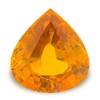
COMMEMORATIVE EVENT - 13th Anniversary
KEYWORDS - Success, Abundance, Personal Power
ALSO KNOWN AS - Merchant's stone, Success stone
COLORS - Pale yellow to brown
OCCURRENCE - Brazil
COLOR ZONING - Tiger stripes or Zebra stripes
 |
|