


Glittering Stones >> Gem Stones History
Gem Stones History
During medieval period a large number of gemstones were known to many cultures.Identifying gemstones which were known in which time and place is harder to ascertain. Such small precious goods could travel vast distances via trading, a trade which had been widespread in the time of the ancient Myceneans (2000BC?). So only through the evidence of archeological finds and writings of gemstones we can be sure which stones reached which cultures. Trade goods were more likely to reach prosperous outwards looking cultures than ones undergoing war, famine or internal unrest.
In general Gemstone is a mineral, rock or petrified material that it could be cut and polished which is collectible or it can be used in jewellery. Other gems are organic, such as amber (fossilised tree resin) and jet (a form of coal). Some beautiful gemstones are too soft or too fragile to be used in jewelry, for example, crystalline rhodochrosite[?], but are exhibited in museums and sought by collectors.
The cubic zirconia is a synthetic diamond substitute which are manufactured to imitate other gemstones. The imitations copies the look and colour of the real stone but does not possess their chemical or physical characteristics. However, synthetic gemstones are not necessarily imitation. For example, diamond, ruby, sapphire and emerald can be manufactured in labs, which possess identical chemical and physical characteristics as the genuine article. Artificial corundums including ruby and sapphire are very common and they cost only a fraction of the natural stones. Artificial diamonds are manufactured as industrial abrasives. However, artificial diamonds in gemstone-quality on the other hand are still too costly to manufacture.
A gemstone is prized especially for great beauty or perfection.
Hence, appearance is almost the most important attribute of gemstones.
Their beauty must also be able to stand the test of time; if a
gemstone is scratched or crumbled, it loses its value instantly.
Characteristics that make a stone beautiful or desirable are colour,
unusual optical phenomena within the stone, an interesting inclusion
such as a fossil, rarity and sometimes the shape of the natural
crystal. It is unsurprising that diamond is prized
highly as a gemstone, since it is the hardest substance known
and is able to reflect light with fire and sparkle.
In the jewellery industry, gemstones are classified into precious
stones and semi-precious
stones.
Gemstones are described and differentiated by gemologists by certain technical specifications. First, what is it made of, its composition. Diamonds for example are made of carbon, rubies of Aluminum Oxide, Al2O3. Next, many gems are crystals which are classified by crystal system[?] such as cubic or trigonal or monoclinic. Another term used is habit, the form the gem is usually found in, for example diamonds which have a cubic crystal system are often found as octahedrons.
Gems come in different "varieties", for example corundum is found as ruby, and sapphires of various colors; diamond in various Types; beryl as emerald, aquamarine, bixbite (red), goshenite (colorless), heliodor (yellow), morganite (pink).
Gems have a certain refractive index, a certain dispersion, a certain specific gravity, a certain hardness, a certain cleavage, a certain fracture, a certain lustre. They may exhibit pleochroism of a certain sort, or double refraction to a certain degree and have an optic sign[?]. They may have a certain luminescence and a distinctive absorption spectrum[?].
Certain material may be present as inclusions. And the gem may occur in certain locations, "occurrence." Gems from different locations may display different characteristics which may aid in identification.
NOVEMBER BIRTHSTONE - CITRINE
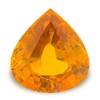
COMMEMORATIVE EVENT - 13th Anniversary
KEYWORDS - Success, Abundance, Personal Power
ALSO KNOWN AS - Merchant's stone, Success stone
COLORS - Pale yellow to brown
OCCURRENCE - Brazil
COLOR ZONING - Tiger stripes or Zebra stripes
 |
|